The need for continuous IT infrastructure monitoring is no longer up for debate. Today, virtually every IT leader understands the value of proactive oversight, rapid intervention, and preventive action in maintaining the performance of critical digital services. The conversation has evolved into a far more practical one: how monitoring is implemented, which tools and resources are involved, and whether it is more effective to build these capabilities in-house or outsource them to a specialized Network Operations Center (NOC).
In this context, Datanet Systems stands out as one of the few companies in Romania operating a fully functional NOC. The center runs 24/7/365 and is supported by a team of 12 highly skilled engineers with strong telecom and IT expertise. This consolidated know-how enables not only rapid incident response, but also continuous optimization of IT operations—reducing downtime, improving performance, and increasing infrastructure predictability. For organizations with mission-critical environments, the Datanet NOC can ensure hardware replacement within a maximum of four hours.

Who needs a NOC — and why?
The need for a NOC is not driven by the desire to add another IT function, but by the growing pressure on businesses to operate without disruption. Any organization that relies on applications, networks, or digital platforms will eventually reach a point where availability becomes business-critical. In sectors such as finance or retail, even brief outages can translate into immediate revenue loss and reputational impact. In industrial environments, downtime can halt production altogether.
A NOC, therefore, is not just about resolving incidents, it establishes a structured operational framework where issues are anticipated, prioritized, and efficiently managed. A professional Network Operations Center delivers tangible business value:
- Maximized availability of IT services
- Reduced financial impact of downtime
- Enhanced operational control and infrastructure management
- Lower security risks through early anomaly detection
By combining advanced technology, proven methodologies, and operational expertise, a NOC provides end-to-end visibility across the infrastructure, enabling faster and better-informed decisions.
Why IT infrastructure monitoring is business-critical
Every digital service depends on a complex ecosystem of interconnected systems, applications, and data flows that must operate seamlessly and predictably. In most cases, incidents do not occur suddenly—they develop gradually, manifesting as performance degradation, increased latency, or irregular system behaviour. Many organizations still monitor infrastructure in silos, with separate teams responsible for networks, virtual environments, or applications, often lacking unified coordination. Without continuous, centralized monitoring, these early warning signals remain undetected until they escalate into major incidents.
A NOC addresses this challenge by correlating data across all infrastructure layers, enabling faster root cause identification and significantly reducing resolution times. As a result, modern organizations increasingly view monitoring not as a standalone technical task, but as a strategic capability. A well-implemented NOC enables the shift from a reactive model—where issues are addressed after they occur—to a proactive one, where incidents are prevented before impacting end users.
Without this level of visibility, the business consequences are immediate:
- Revenue loss and reduced customer satisfaction
- SLA breaches and compliance exposure
- Increased vulnerability to security incidents
- Inefficient use of resources
- Rising operational costs
Conversely, a well-managed NOC directly contributes to operational resilience, cost efficiency, and brand protection.
Datanet NOC operating model
At the core of Datanet Systems’ service portfolio, the Network Operations Center functions as a centralized hub for monitoring, operational management, and incident coordination. To ensure efficiency and scalability, the NOC is structured across three levels of expertise:
- Level 1 (L1): 24/7 monitoring and first-line support, handling standard incidents
- Level 2 (L2): Advanced troubleshooting and resolution of complex issues
- Level 3 (L3): Deep technical expertise and direct engagement with technology vendors
Single Point of Contact (SPOC)
A key differentiator is the NOC’s role as a Single Point of Contact (SPOC). Clients no longer need to coordinate multiple vendors or internal teams—the NOC assumes full ownership of service delivery. In practical terms, this reduces operational overhead, eliminates communication gaps, and ensures consistent service management. All requests are centrally logged, prioritized, and managed, resulting in faster resolution times and a more predictable service experience.
Processes and Capabilities – NOC operations are built on standardized processes and modern infrastructure, ensuring full traceability, transparency, and predictability.
Access channels include:
- A support portal with real-time visibility
- Dedicated email for non-critical requests
- A 24/7 hotline for critical incidents
The NOC is hosted in a secure, fully redundant environment (UPS, connectivity, backup systems), ensuring uninterrupted service delivery.
- Service Scope: from Reactive to Proactive – Datanet NOC services are designed with a clear objective: to maximize infrastructure performance and availability while minimizing operational risk and cost.
- Incident Management – Speed of response is critical. The NOC provides rapid diagnosis and coordinated intervention—remote or on-site—with hardware replacement capabilities of up to four hours, significantly reducing downtime.
- Monitoring and Event Management – The real value lies in proactive operations. By aggregating and correlating alerts and logs, the NOC identifies early indicators of degradation and prevents escalation into critical incidents.
- Preventive Maintenance – Long-term stability depends on eliminating root causes, not just addressing symptoms. Root cause analysis and scheduled maintenance ensure a more resilient and predictable infrastructure.
These services are designed to support continuous, optimized IT operations, with a strong focus on performance and availability of critical services. A structured, proactive approach reduces disruption-related losses while ensuring efficient handling of incidents and operational requests.
At the same time, strict adherence to KPIs and SLA commitments ensures transparency and predictability. All activities and escalations are centrally coordinated, ensuring fast, consistent interventions with minimal business impact.
Service Levels (SLA)
A defining characteristic of the Datanet NOC is its disciplined approach to meeting performance commitments. Service levels are categorized based on business impact:
| Severity | Description | Impact |
| Sev 1 (Critical) | Complete outage of essential services | Major – No workaround available. |
| Sev 2 (High) | Partial service degradation or reduced performance | Significant – Temporary workarounds may exist |
| Sev 3 (Medium) | Limited impact on core operations | Low – Affects non-critical functions |
| Sev 4 (Low) | Requests for information or clarification | Minimal – No operational impact |
*Under a standard 24/7 model, Severity 1 incidents benefit from response times as low as 30 minutes, with estimated restoration within four hours. All metrics are tracked transparently through integrated monitoring and alarm management platforms.
Service Packages and Engagement Models
Datanet Systems offers three core service tiers – Standard, Plus, and Premium – allowing organizations to select the level of monitoring, responsiveness, and proactivity aligned with their operational requirements and business priorities.
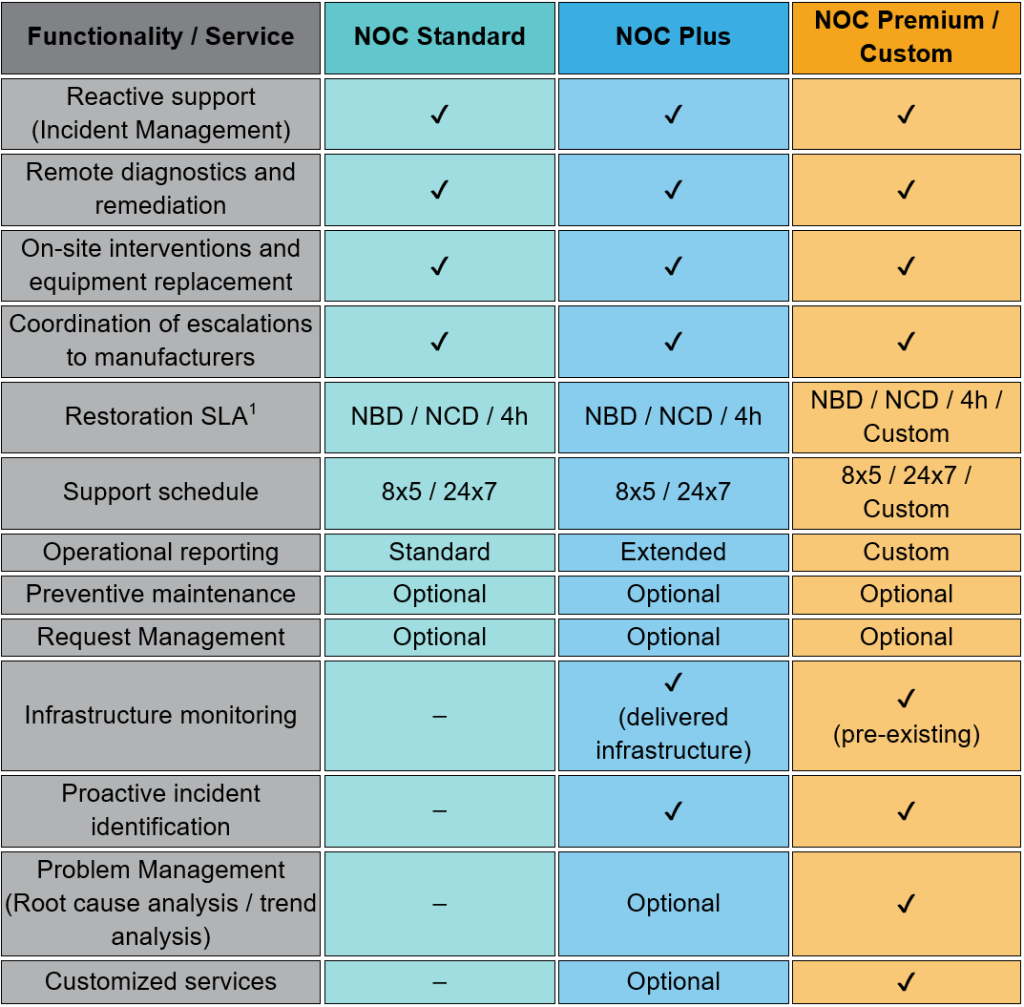
1: upon the severity level of the request, the agreed support schedule, and the contractual terms established.
Responsibilities and Security
Successful service delivery is built on close alignment and clear accountability between all parties involved – Datanet Systems is responsible for ensuring the availability and continuous operation of the NOC, allocating the appropriate technical resources, and managing escalations to technology vendors where required. The client, in turn, is responsible for providing accurate and timely information during incident reporting, enabling the necessary access (remote or on-site), and approving the implementation of agreed changes.
Security and confidentiality are upheld through internationally recognized certifications, including ISO/IEC 27001 (Information Security Management) and ISO/IEC 20000-1 (IT Service Management). Access to client environments is strictly governed by the need-to-know principle and is granted exclusively for the purpose of delivering contracted services.
Through its NOC, Datanet Systems provides a mature operational framework grounded in international best practices and supported by deep technical expertise. Whether enabling proactive monitoring of complex environments or delivering rapid on-site intervention at a national scale, the Datanet NOC enhances infrastructure resilience and operational stability—allowing organizations to remain focused on their strategic business priorities.
Please feel free in contacting us at sales@datanets.ro to schedule a discussion to explore which NOC service package – Standard, Plus, or Premium – best aligns with your current infrastructure and operational needs.
 Automation and AI agents in the new...